


Figure 5
Download original image
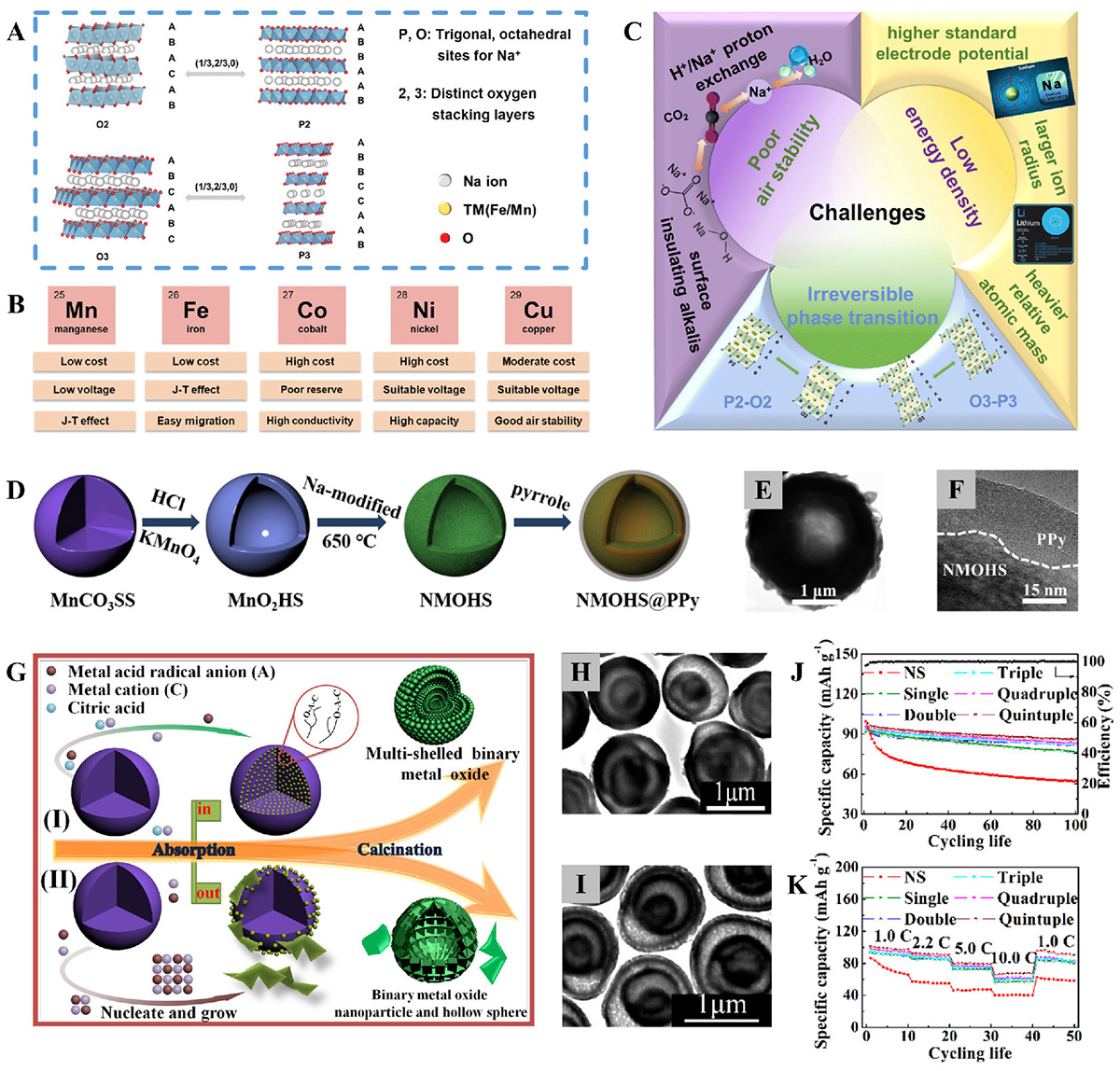
(A) Four types of layered oxide cathode materials: O2, O3, P2, and P3. P and O represent different polyhedral coordination environments of sodium ions, O indicates that Na ions are located in the octahedral coordination center, and P represents Na ions located in the triangular prismatic coordination center. The number represents the TMO6 octahedral layer stacked with oxygen ions. Reproduced with permission from Ref. [152]. Copyright©2024, Wiley‐VCH GmbH. (B) Features of Mn-, Fe-, Co-, Ni-, and Cu-based redox in layered oxides. Reproduced with permission from Ref. [153]. Copyright©2024, The Royal Society of Chemistry. (C) Challenges associated with layered oxide cathode for SIBs. Reproduced with permission from Ref. [154]. Copyright©2024, The Royal Society of Chemistry. (D) Schematic illustration for the fabrication of NMOHS and NMOHS@PPy. (E, F) TEM images of NMOHS@PPy. (D–F) Reproduced with permission from Ref. [156]. Copyright©2019, American Chemical Society. (G) Process for synthesizing multishelled binary metal oxide hollow spheres. (I) With citric acid, the precipitation reaction was extremely restrained due to the chelation of citric acid; thus, metal ions can penetrate into the inside of the CMS templates, resulting in multishelled hollow spheres. (II) Without citric acid, the precursor of the binary metal oxide will be precipitated on the surface of carbon microspheres, resulting in nanoparticles and irregular single-shelled hollow spheres. (H) TEM image of quadruple-shelled hollow spheres. (I) TEM image of quintuple-shelled hollow spheres. (J) Cycling life test and (K) rate performance of Fe2(MoO4)3 NS and multishelled Fe2(MoO4)3 hollow spheres as cathode materials for sodium-ion batteries. (G–K) Reproduced with permission from Ref. [157]. Copyright©2018, American Chemical Society.
Current usage metrics show cumulative count of Article Views (full-text article views including HTML views, PDF and ePub downloads, according to the available data) and Abstracts Views on Vision4Press platform.
Data correspond to usage on the plateform after 2015. The current usage metrics is available 48-96 hours after online publication and is updated daily on week days.
Initial download of the metrics may take a while.