


| Issue |
Natl Sci Open
Volume 5, Number 2, 2026
|
|
|---|---|---|
| Article Number | 20260006 | |
| Number of page(s) | 3 | |
| Section | Materials Science | |
| DOI | https://doi.org/10.1360/nso/20260006 | |
| Published online | 20 January 2026 | |
COMMENTARY
Imperceptible biointerfaces enabled by hydrogel-elastomer-based conductive nanomembranes
1
Department of Materials Science and Engineering, Southern University of Science and Technology, Shenzhen 518055, China
2
Guangdong Provincial Key Laboratory of Sustainable Biomimetic Materials and Green Energy, Institute of Innovative Materials, Southern University of Science and Technology, Shenzhen 518055, China
* Corresponding author (email: This email address is being protected from spambots. You need JavaScript enabled to view it.
)
Received:
14
January
2026
Accepted:
19
January
2026
Soft bioelectronics hold immense potential across diverse applications, notably in healthcare, human-machine interfaces, and conformal neural interfaces. A core driving force is the pursuit of high-fidelity, seamless integration between electronic systems and biological tissues, enabling the long-term stable monitoring of biosignals and precise diagnosis and therapy within closed-loop configurations. The past decade has seen transformative growth in this field, yielding numerous novel conformal integration strategies. These include seminal developments such as ultra-thin epidermal electronics [1,2], conformal bioelectronics fabrication or encapsulation using viscoplastic effect [3,4], and a “drop-printing” strategy for damage-free, conformal wrapping of bioelectronic interfaces through dynamic stress release [5]. However, a fundamental trade-off in the clinical translation of bioelectronics lies between practical handleability ex vivo (pre-implantation) and the demand for mechanical conformability in vivo [6]. To realize imperceptible biointerfaces—platforms avoiding mechanical stress or chronic tissue compression—devices must be nanoscale-thin and ultrasoft. Yet, such nanofilms are fragile and difficult to manipulate during conventional microfabrication and transfer steps, impeding their clinical translation and scalability.
Now, writing in Nature Nanotechnology, Son, Kim and colleagues [7] report a transformable and imperceptible hydrogel-elastomer adhesive bilayer based on ionic-electronic conductive nanomembranes (THIN) that elegantly resolves the fundamental trade-off between device handleability and mechanical conformability. This work shifts the design paradigm from static mechanical matching to dynamic, stimuli-responsive mechanical decoupling.
THIN is fabricated via an orthogonal solvent spin-coating process, forming a 350-nm-thick bilayer heterostructure, composed of a 90 nm hydrophobic semiconducting elastomer (poly(2-(3,3′-bis(2-(2-(2-methoxyethoxy)ethoxy)ethoxy)-[2,2′-bithiophen]-5)yl selenophene) (P(g2T2-Se)) layer and a 260 nm hydrophilic adhesive hydrogel (catechol-conjugated alginate (Alg-CA)) layer (Figure 1a). This design leverages the dynamic mechanical response of the Alg-CA layer to resolve the conflict between device fabrication and biological application. In the dry state, a high Young’s modulus of 1.35 GPa provides structural integrity, ensuring compatibility with standard microfabrication processes. Upon contact with physiological fluids, the hydrogel layer rapidly hydrates, triggering an instantaneous “rigid-to-soft” phase transition, where the modulus plummets to 0.035 GPa, resulting in an extremely low bending stiffness (Figure 1b). This mechanical softening enables the THIN-based device to spontaneously establish seamless conformal contact with complex tissues featuring microscale curvatures (<5 μm), effectively eliminating interfacial gaps and stress concentrations and thereby enabling nearly imperceptible integration.
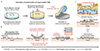 |
Figure 1 Fabrication, self-adaptation, and biosignal monitoring mechanisms of THIN. (a) Schematic of the fabrication process for THIN, where OLA denotes orthogonal-layered assembly. (b) Schematic of the possible mechanism of self-adaptation of THIN on a moisturized tissue. (c) Direct conformal adhesion is achieved by a thin channel and a wet tissue surface. Adapted from Ref. [7]. Copyrighy 2025, Springer Nature Limited. |
Besides the mechanical design, the authors also optimized the electrical performance of the semiconducting elastomer. The authors synthesized a novel semiconducting elastomer, P(g2T2-Se), by substituting sulfur atoms in P(g2T2-T) with selenium (Se) atoms. This selenium-substitution strategy enhanced the π-π stacking between polymer chains and increased the material’s crystallinity, thereby optimizing its mixed ion-electron conduction efficiency. Consequently, the organic electrochemical transistor (OECT) devices integrated with THIN achieved record-breaking performance: μC* (μ, charge-carrier mobility; C*, volumetric capacitance) as high as 1034 F cm−1 V−1 s−1. In addition to the superior electrical properties, the nano-scale functional layers shorten the effective distance between THIN-OECT and the tissue, accelerating mixed ion-electron conduction. This synergistic effect enables high-gain amplification of weak signals directly at the bio-interface, enhancing signal acquisition accuracy and the signal-to-noise ratio (Figure 1c). Furthermore, the resulting THIN-OECT demonstrated exceptional mechanical and electrical stability. The device remained fully functional under a tensile strain of up to 200%. Electrically, it exhibited remarkable reliability: an impedance of 138.4 ± 1.53 Ω at 1 kHz, an on/off ratio >3600, and a sustained stability over 20000 cycles. The THIN-OECT demonstrates its applicability in complex biological environments through stable adhesion and signal integrity, enabling high-precision monitoring of diverse physiological signals, including epicardial electrograms (EGM), electromyograms (EMG), and electrocorticograms (ECoG).
The introduction of THIN represents a major advance in soft bioelectronics. However, several challenges remain on the path to clinical translation. The adhesive stability of THIN in dynamic biological environments requires long-term assessment over months or years. Scaling the orthogonal solvent spin-coating process to large-scale, low-cost manufacturing while guaranteeing defect-free uniformity remains a significant engineering bottleneck. Moreover, precise integration technologies are needed to incorporate THIN into complex multifunctional circuits and wireless systems without introducing mechanical loads from rigid interconnects. Despite these hurdles, the instantaneous rigid-to-soft transition effectively addresses the conflict between handleability and conformability. It opens a clear path for the next generation of truly imperceptible bioelectronic interfaces.
Conflict of interest
The authors declare no conflict of interest.
References
- Kim DH, Lu N, Ma R, et al. Epidermal electronics. Science 2011; 333: 838-843. [Article] [Google Scholar]
- Jiang Z, Chen N, Yi Z, et al. A 1.3-micrometre-thick elastic conductor for seamless on-skin and implantable sensors. Nat Electron 2022; 5: 784-793. [Article] [Google Scholar]
- Lee S, Kum J, Kim S, et al. A shape-morphing cortex-adhesive sensor for closed-loop transcranial ultrasound neurostimulation. Nat Electron 2024; 7: 800-814. [Article] [Google Scholar]
- Xia R, Li C, Shao Y, et al. Hermetic stretchable seals enabled by a viscoplastic surface effect. Nat Mater 2025; 24: 2011-2018. [Article] [Google Scholar]
- Li A, Zhou W, Li H, et al. Drop-printing with dynamic stress release for conformal wrap of bioelectronic interfaces. Science 2025; 389: 1127-1132. [Article] [Google Scholar]
- Liu S, Rao Y, Jang H, et al. Strategies for body-conformable electronics. Matter 2022; 5: 1104-1136. [Article] [Google Scholar]
- Jung H, Lee D, Kim K, et al. Hydrogel-elastomer-based conductive nanomembranes for soft bioelectronics. Nat Nanotechnol 2025; 20: 1822-1830. [Article] [Google Scholar]
© The Author(s) 2026. Published by Science Press and EDP Sciences.
 This is an Open Access article distributed under the terms of the Creative Commons Attribution License (https://creativecommons.org/licenses/by/4.0), which permits unrestricted use, distribution, and reproduction in any medium, provided the original work is properly cited.
All Figures
|
Figure 1 Fabrication, self-adaptation, and biosignal monitoring mechanisms of THIN. (a) Schematic of the fabrication process for THIN, where OLA denotes orthogonal-layered assembly. (b) Schematic of the possible mechanism of self-adaptation of THIN on a moisturized tissue. (c) Direct conformal adhesion is achieved by a thin channel and a wet tissue surface. Adapted from Ref. [7]. Copyrighy 2025, Springer Nature Limited. |
| In the text | |
Current usage metrics show cumulative count of Article Views (full-text article views including HTML views, PDF and ePub downloads, according to the available data) and Abstracts Views on Vision4Press platform.
Data correspond to usage on the plateform after 2015. The current usage metrics is available 48-96 hours after online publication and is updated daily on week days.
Initial download of the metrics may take a while.